Christmas is about the resurrected living God the Father’s resurrected living Beloved Son Jesus Christ, Jesua, The Great Messiah, who soon will come in power and great glory to rule and reign in Millennial joy and splendor.

You can translate this post into multiple languages. Just click TRANSLATE and click the flag of the country language. If you would like to talk to me or to missionaries and be baptized and join the Church of Jesus Christ of Latter-day Saints, jot me a note at Richard Linford, editor, r.linford@comcast.net and take a few minutes to explore https://www.churchofjesuschrist.org/?lang=eng
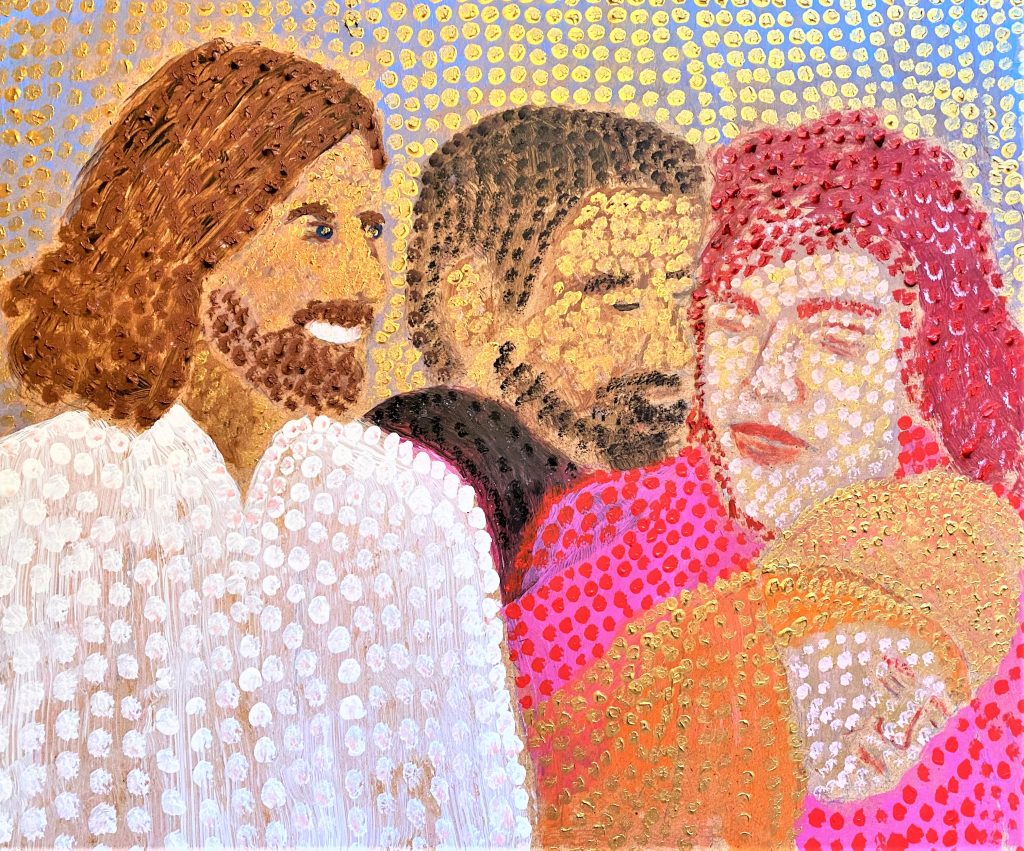
My painting of Jesus smiling on a family.

Question. What is The True Nature of God the Father?

Answer. Jesus Christ was [and is] the perfect manifestation of the perfect Father’s person, personality, and his loving kindness and care.

After generations of prophets had tried to teach the family of man the will and the way of the Father,

usually with little success,

God in His ultimate effort to have us know Him,

sent to earth His Only Begotten and perfect Son,

created in His very likeness and image,

to live and serve among mortals

in the everyday rigors of life.

  1. Question. What is Jesus Christ’s assignment from The Father?
  2. Answer. To stand in the place of and represent Our Heavenly Father to us His children.
  3. To come to earth with such a responsibility,
  4. to stand in place of Heavenly Father
  5. —speaking as He would speak,
  6. judging and serving,
  7. loving and warning,
  8. forbearing and forgiving
  9. as He would do
  10. —this is a duty of such staggering proportions
  11. that you and I cannot comprehend such a thing.
  12. But in the loyalty
  13. and determination
  14. that would be characteristic of a divine child,
  15. Jesus could comprehend it
  16. and He did it.

  1. Question. Who gets the honor and glory?
  2. Answer. The Son did and does all he saw and sees the Father do, says all the Father asks Him to say, and gives all praise and honor and adulation to the Father.
  3. Then, when the praise and honor began to come, Jesus humbly directed all adulation to the Father.
  4. “The Father … doeth the works,” He said in earnest.
  5. “The Son can do nothing of himself,
  6. but what he seeth the Father do:
  7. for what things soever [the Father] doeth,
  8. these also doeth the Son likewise”
  9. [John 14:10John 5:19].
  10. On another occasion He said:
  11. “I speak that which I have seen with my Father”
  12. [John 8:38]. …

  1. Question. But aren’t we estranged from Our Heavenly Father and the Son?
  2. Answer. No. Our Father is the same, yesterday, today, and forever, as is His Beloved Son.
  3. … Some in the contemporary world
  4. suffer from a distressing misconception
  5. of [God our Eternal Father].
  6. Among these there is a tendency to feel distant from the Father,
  7. even estranged from Him,
  8. if they believe in Him at all.
  9. … Through a misreading
  10. (and surely, in some cases, a mistranslation)
  11. of the Bible,
  12. these see God the Father
  13. and Jesus Christ His Son
  14. as operating very differently,
  15. this in spite of the fact
  16. that in both the Old Testament
  17. and the New,
  18. the Son of God is one
  19. and the same,
  20. acting as He always does
  21. under the direction of the Father,
  22. who is Himself the same
  23. “yesterday,
  24. today,
  25. and forever.”1 …

  1. Question. What did and does the Father do?
  2. Answer. Feed the hungry, heal the sick, rebuke hypocrisy, plead for faith.
  3. What did and does the Son do?
  4. Answer. That which the Father does.
  5. So
  6. feeding the hungry,
  7. healing the sick,
  8. rebuking hypocrisy,
  9. pleading for faith
  10. —this was Christ
  11. showing us the way of the Father,
  12. He who is
  13. “merciful
  14. and gracious,
  15. slow to anger,
  16. long-suffering
  17. and full of goodness.”2 
  18. In His life
  19. and especially in His death,
  20. Christ was declaring,
  21. “This is God’s compassion
  22. I am showing you,
  23. as well as that of my own.”
  24. In the perfect Son’s manifestation
  25. of the perfect Father’s care,
  26. in Their mutual suffering
  27. and shared sorrow
  28. for the sins
  29. and heartaches
  30. of the rest of us,
  31. we see ultimate meaning in the declaration [and summary]:
  32. “For God so loved the world,
  33. that he gave his only begotten Son,
  34. that whosoever believeth in him
  35. should not perish,
  36. but have everlasting life.
  37. For God sent not his Son into the world to condemn the world;
  38. but that the world
  39. through him
  40. might be saved”
  41. [John 3:16–17].

  1. Question. What then is Our challenge and opportunity?
  2. Answer. Do what Our Savior did!
  3. FEED THE HUNGRY
  4. HEAL THE SICK
  5. REBUKE HYPOCRISY
  6. PLEAD FOR FAITH
  7. BE MERCIFUL
  8. BE GRACIOUS
  9. BE SLOW TO ANGER
  10. BE LONG-SUFFERING
  11. BE FULL OF GOODNESS
  12. BE COMPASSIONATE
  13. CARE PERFECTLY
  14. SUFFER MUTUALLY WITH THEM
  15. SHARE SORROW WITH THEM FOR THE SINS AND HEARTACHES OF THE WORLD
  16. TEACH MEN, WOMEN, AND CHILDREN TO BELIEVE ON THEM
  17. DIRECT ALL HONOR AND GLORY TO THE FATHER AND THE SON AND THE HOLY GHOST

  1. Question. Is God the Father the Supreme Being, the ultimate Creator, Ruler, Preserver of all things?
  2. Answer. Yes.
  3. Our Heavenly Father is the Supreme Being
  4. in whom we believe,
  5. whom we worship,
  6. and to whom we pray.
  7. He is the ultimate Creator,
  8. Ruler,
  9. and Preserver
  10. of all things.
  11. He is perfect,
  12. has all power,
  13. and knows all things.

  1. Question. Does Heavenly Father have form and substance?
  2. Answer. Yes. Like His Son, He too has a glorified body of flesh and bones.
  3. He “has a body of flesh
  4. and bones
  5. as tangible as man’s”
  6. (Doctrine and Covenants 130:22).

  1. Question. Is Heavenly Father the literal father of our spirits?
  2. Answer. Yes.
  3. He is The Father of Our Spirits.
  4. He is your Father and my Father.
  5. One of life’s great questions is “Who am I?”
  6. A beloved Primary song helps even little children answer this question.
  7. We sing,
  8. “I am a child of God,
  9. and he has sent me here.”
  10. The knowledge that we are children of God
  11. provides strength,
  12. comfort,
  13. and hope.

  1. Question. Did early Christians know  and teach anthropomorphic doctrine about God The Father?
  2. Answer. Yes. And as His children, thru the power of the resurrection we shall become like Him.
  3. Scholars have long acknowledged
  4. that the view of God held by the earliest Christians
  5. changed dramatically over the course of centuries.
  6. Early Christian views of God were
  7. more personal,
  8. more anthropomorphic,
  9. and less abstract
  10. than those that emerged later
  11. during Christianity’s creedal stage.

  1. Question. What happened to change the doctrine held by early Christians?
  2. Answer. Apostolic authority was lost and in grave error Christian doctrine about the anthropomorphic doctrine of God the Father was merged with Greek philosophy.
  3. The key ideological shift
  4. that began in the second century,
  5. after the loss of apostolic authority,
  6. resulted from a conceptual merger
  7. of Christian doctrine
  8. with Greek philosophy.
  9. Latter-day Saints believe
  10. the melding of early Christian theology
  11. with Greek philosophy
  12. was a grave error.
  13. Chief among the doctrines
  14. lost in this process
  15. was the nature of the Godhead.
  16. Latter-day Saints hold that God the Father is
  17. an embodied being
  18. with the attributes
  19. ascribed by the earliest Christians.
  20. That belief is consistent
  21. with the early Christian views of God,
  22. yet it differs from the later creeds.

  1. Question. So we are literal children of God?
  2. Answer. Yes.
  3. We are all literally children of God,
  4. spiritually begotten in the premortal life.
  5. As His children,
  6. we can be assured
  7. that we have divine,
  8. eternal potential
  9. and that He will help us
  10. in our sincere efforts
  11. to reach that potential.

  1. Question. So the living, resurrected, exalted, glorified man God the Father is the Supreme Creator.
  2. Yes. Through the living, resurrected, exalted, glorified man God the Son, Jesus the  Christ, Jesua, the Holy Messiah.
  3. Our Father is The Supreme Creator
  4. Heavenly Father is the Supreme Creator.
  5. Through Jesus Christ,
  6. He created heaven and earth
  7. and all things in them
  8. (see Moses 2:1).

  1. Question. So all things bear witness of the Father and of the Son?
  2. Answer. Yes.
  3. Alma said, “All things denote there is a God;
  4. yea, even the earth,
  5. and all things that are upon the face of it,
  6. yea, and its motion,
  7. yea, and also all the planets
  8. which move in their regular form
  9. do witness
  10. that there is a Supreme Creator”
  11. (Alma 30:44).

  1. Question. Then Our Heavenly Father is The Author of the Plan of Salvation for His children?
  2. Answer. Yes.
  3. Our Father in Heaven is The Author of the Plan of Salvation
  4. Our Father in Heaven wants us to dwell with Him eternally.
  5. His work and glory is “to bring to pass the immortality and eternal life of man”
  6. (Moses 1:39).
  7. In order to make this possible,
  8. He prepared the plan of salvation.
  9. He sent His Beloved Son, Jesus Christ,
  10. to loose the bands of death
  11. and atone for the sins of the world:
  12. “For God so loved the world,
  13. that he gave his only begotten Son,
  14. that whosoever believeth in him
  15. should not perish,
  16. but have everlasting life”
  17. (John 3:16).

  1. Question. Is it true, then, that Our Heavenly Father’s sacrifice of His Beloved Son is the greatest expression of His love for us?
  2. Answer. Yes.
  3. This sacrifice of Jesus Christ by His Father
  4. is the greatest expression
  5. of our Father’s love for us.
  6. Question. How can we know Heavenly Father?
  7. Answer. Pray to Him. Know and obey and follow His Son.
  8. How can we Come to Know God the Father?
  9. As children of God,
  10. we have a special relationship with Him,
  11. setting us apart from all His other creations.
  12. We should seek to know our Father in Heaven.
  13. He loves us,
  14. and He has given us the precious opportunity
  15. to draw near to Him
  16. as we pray.
  17. Our prayers,
  18. offered in humility
  19. and sincerity,
  20. are heard
  21. and answered.
  22. We can also come to know our Father
  23. by learning about His Beloved Son
  24. and applying the gospel in our lives.

  1. Question. So once again, you are saying that we can know Our Heavenly Father by knowing His Son?
  2. Answer. Yes.
  3. The Savior taught His disciples:
  4. “If ye had known me,
  5. ye should have known my Father also.
  6. … He that hath seen me
  7. hath seen the Father”
  8. (John 14:7, 9).

Source – quoting Elder Jeffrey R. Holland, “The Grandeur of God,” Ensign, Nov. 2003, 70–73.

Views: 132

Love your enemies. Jesus is the Christ, the Holy Messiah.

  1. Love Your Enemies
  2. By President Dallin H. Oaks (paragraphs 1-105)
  3. First Counselor in the First Presidency
  4.  
  5. Knowing that we are all children of God gives us a vision of the worth of others and the ability to rise above prejudice.
  6. The Lord’s teachings are for eternity and for all of God’s children.
  7. In this message I will give some examples from the United States, but the principles I teach are applicable everywhere.
  8. We live in a time of anger and hatred in political relationships and policies.
  9. We felt it this summer when some went beyond peaceful protests and engaged in destructive behavior.
  10. We feel it in some current campaigns for public offices.
  11. Unfortunately, some of this has even spilled over into political statements and unkind references in our Church meetings.
  12. In a democratic government we will always have differences over proposed candidates and policies.
  13. However, as followers of Christ we must forgo the anger and hatred with which political choices are debated or denounced in many settings.
  14. The Sermon on the Mount
  15. Here is one of our Savior’s teachings, probably well known but rarely practiced:
  16. “Ye have heard that it hath been said, Thou shalt love thy neighbour, and hate thine enemy.
  17. “But I say unto you, Love your enemies, bless them that curse you, do good to them that hate you, and pray for them which despitefully use you, and persecute you” (Matthew 5:43–44).1
  18. For generations, Jews had been taught to hate their enemies, and they were then suffering under the domination and cruelties of Roman occupation.
  19. Yet Jesus taught them, “Love your enemies” and “do good to them that … despitefully use you.”
  20. Bring forth the record
  21. What revolutionary teachings for personal and political relationships!
  22. But that is still what our Savior commands.
  23. In the Book of Mormon we read,
  24. “For verily, verily I say unto you, he that hath the spirit of contention is not of me, but is of the devil, who is the father of contention, and he stirreth up the hearts of men to contend with anger, one with another” (3 Nephi 11:29).
  25. Loving our enemies and our adversaries is not easy.
  26. “Most of us have not reached that stage of … love and forgiveness,”
  27. President Gordon B. Hinckley observed, adding, “It requires a self-discipline almost greater than we are capable of.”2 
  28. But it must be essential, for it is part of the Savior’s two great commandments to “love the Lord thy God” and to “love thy neighbour as thyself” (Matthew 22:37, 39).
  29. And it must be possible, for He also taught, “Ask, and it shall be given you; seek, and ye shall find” (Matthew 7:7).3
  30. How do we keep these divine commandments in a world where we are also subject to the laws of man?
  31. Fortunately, we have the Savior’s own example of how to balance His eternal laws with the practicalities of man-made laws.
  32. When adversaries sought to trap Him with a question about whether Jews should pay taxes to Rome, He pointed to the image of Caesar on their coins and declared, “Render therefore unto Caesar the things which be Caesar’s, and unto God the things which be God’s” (Luke 20:25).4
  33. Jesus Christ. Tribute to Caesar
  34. So, we are to follow the laws of men (render unto Caesar) to live peacefully under civil authority, and we follow the laws of God toward our eternal destination.
  35. But how do we do this—especially how do we learn to love our adversaries and our enemies?
  36. The Savior’s teaching not to “contend with anger” is a good first step.
  37. The devil is the father of contention, and it is he who tempts men to contend with anger.
  38. He promotes enmity and hateful relationships among individuals and within groups.
  39. President Thomas S. Monson taught that anger is “Satan’s tool,” for “to be angry is to yield to the influence of Satan.
  40. No one can make us angry. It is our choice.”5 
  41. Anger is the way to division and enmity.
  42. We move toward loving our adversaries when we avoid anger and hostility toward those with whom we disagree.
  43. It also helps if we are even willing to learn from them.
  44. Among other ways to develop the power to love others is the simple method described in a long-ago musical.
  45. When we are trying to understand and relate to people of a different culture, we should try getting to know them.
  46. In countless circumstances, strangers’ suspicion or even hostility give way to friendship or even love when personal contacts produce understanding and mutual respect.6
  47. An even greater help in learning to love our adversaries and our enemies is to seek to understand the power of love.
  48. Here are three of many prophetic teachings about this.
  49. The Prophet Joseph Smith taught that “it is a time-honored adage that love begets love. Let us pour forth love—show forth our kindness unto all mankind.”7
  50. President Howard W. Hunter taught: “The world in which we live would benefit greatly if men and women everywhere would exercise the pure love of Christ, which is kind, meek, and lowly.
  51. It is without envy or pride. … It seeks nothing in return. … It has no place for bigotry, hatred, or violence. … It encourages diverse people to live together in Christian love regardless of religious belief, race, nationality, financial standing, education, or culture.”8
  52. And President Russell M. Nelson has urged us to “expand our circle of love to embrace the whole human family.”9
  53. An essential part of loving our enemies is to render unto Caesar by keeping the laws of our various countries.
  54. Though Jesus’s teachings were revolutionary, He did not teach revolution or lawbreaking. He taught a better way.
  55. Modern revelation teaches the same:
  56. “Let no man break the laws of the land, for he that keepeth the laws of God hath no need to break the laws of the land.
  57. “Wherefore, be subject to the powers that be” (Doctrine and Covenants 58:21–22).
  58. And our article of faith, written by the Prophet Joseph Smith after the early Saints had suffered severe persecution from Missouri officials, declares, “We believe in being subject to kings, presidents, rulers, and magistrates, in obeying, honoring, and sustaining the law” (Articles of Faith 1:12).
  59. This does not mean that we agree with all that is done with the force of law.
  60. It means that we obey the current law and use peaceful means to change it.
  61. It also means that we peacefully accept the results of elections.
  62. We will not participate in the violence threatened by those disappointed with the outcome.10
  63.  In a democratic society we always have the opportunity and the duty to persist peacefully until the next election.
  64. The Savior’s teaching to love our enemies is based on the reality that all mortals are beloved children of God.
  65. That eternal principle and some basic principles of law were tested in the recent protests in many American cities.
  66. Protests
  67. At one extreme, some seem to have forgotten that the First Amendment to the United States Constitution guarantees the “right of the people peaceably to assemble, and to petition the Government for a redress of grievances.”
  68. That is the authorized way to raise public awareness and to focus on injustices in the content or administration of the laws.
  69. And there have been injustices.
  70. In public actions and in our personal attitudes, we have had racism and related grievances.
  71. In a persuasive personal essay, the Reverend Theresa A. Dear of the National Association for the Advancement of Colored People (NAACP) has reminded us that “racism thrives on hatred, oppression, collusion, passivity, indifference and silence.”11 
  72. As citizens and as members of The Church of Jesus Christ of Latter-day Saints, we must do better to help root out racism.
  73. Police and Rebels
  74. At the other extreme, a minority of participants and supporters of these protests and the illegal acts that followed them seem to have forgotten that the protests protected by the Constitution are peaceful protests.
  75. Protesters have no right to destroy, deface, or steal property or to undermine the government’s legitimate police powers.
  76. The Constitution and laws contain no invitation to revolution or anarchy.
  77. All of us—police, protesters, supporters, and spectators—should understand the limits of our rights and the importance of our duties to stay within the boundaries of existing law.
  78. Abraham Lincoln was right when he said, “There is no grievance that is a fit object of redress by mob law.”12 
  79. Redress of grievances by mobs is redress by illegal means.
  80. That is anarchy, a condition that has no effective governance and no formal police, which undermines rather than protects individual rights.
  81. One reason the recent protests in the United States were shocking to so many was that the hostilities and illegalities felt among different ethnicities in other nations should not be felt in the United States.
  82. This country should be better in eliminating racism not only against Black Americans, who were most visible in the recent protests, but also against Latinos, Asians, and other groups. This nation’s history of racism is not a happy one, and we must do better.
  83. Ellis Island
  84. Ellis Island
  85. The United States was founded by immigrants of different nationalities and different ethnicities.
  86. Its unifying purpose was not to establish a particular religion or to perpetuate any of the diverse cultures or tribal loyalties of the old countries.
  87. Our founding generation sought to be unified by a new constitution and laws.
  88. That is not to say that our unifying documents or the then-current understanding of their meanings were perfect.
  89. The history of the first two centuries of the United States showed the need for many refinements, such as voting rights for women and, particularly, the abolition of slavery, including laws to ensure that those who had been enslaved would have all the conditions of freedom.
  90. Two Yale University scholars recently reminded us:
  91. “For all its flaws, the United States is uniquely equipped to unite a diverse and divided society. …
  92. “… Its citizens don’t have to choose between a national identity and multiculturalism.
  93. Americans can have both.
  94. But the key is constitutional patriotism.
  95. We have to remain united by and through the Constitution, regardless of our ideological disagreements.”13
  96. Many years ago, a British foreign secretary gave this great counsel in a debate in the House of Commons: “We have no eternal allies and we have no perpetual enemies. 
  97. Our interests are eternal and perpetual, and these interests it is our duty to follow.”14
  98. That is a good secular reason for following “eternal and perpetual” interests in political matters.
  99. In addition, the doctrine of the Lord’s Church teaches us another eternal interest to guide us: the teachings of our Savior, who inspired the Constitution of the United States and the basic laws of many of our countries.
  100. Loyalty to established law instead of temporary “allies” is the best way to love our adversaries and our enemies as we seek unity in diversity.
  101. Knowing that we are all children of God gives us a divine vision of the worth of all others and the will and ability to rise above prejudice and racism.
  102. As I have lived for many years in different places in this nation, the Lord has taught me that it is possible to obey and seek to improve our nation’s laws and also to love our adversaries and our enemies.
  103. While not easy, it is possible with the help of our Lord, Jesus Christ.
  104. He gave this command to love, and He promises His help as we seek to obey it. I testify that we are loved and will be helped by our Heavenly Father and His Son, Jesus Christ.
  105. In the name of Jesus Christ, amen.

Richard W. Linford, editor, member of The Church of Jesus Christ of Latter-day Saints.

Views: 2304

Jesus is Jeshua, Jehovah, the Holy Messiah, Alpha and Omega, who soon will come in power and great glory so repent and get ready and be of good cheer.

  1. Remarks: Be of Good Cheer
  2. By President Dallin H. Oaks
  3. First Counselor in the First Presidency
  4. The Church of Jesus Christ of Latter-day Saints, headquarters Salt Lake City, Utah, USA

Click here for the Temple Square Tabernacle Choir “Let Us All Press On” music https://www.google.com/search?q=let+us+all+press+on+by+the+tabernacle+choir&rlz=1C1GCEA_enUS863US863&oq=Let+us+all&aqs=chrome.1.69i57j35i39j46i457j0l5.4028j0j15&sourceid=chrome&ie=UTF-8

If you want to talk to the missionaries, to get in touch and make an appointment and reach missionaries for a phone call or online face to face call 1-801-240-1000 or check out toll free numbers depending on where you are in the world at this internet link: https://www.churchofjesuschrist.org/help/support/toll-free-numbers-gsc?lang=eng/.

  1. Our unshakable faith in the doctrine of the restored gospel of Jesus Christ guides our steps and gives us joy.
  2. In the final days of His mortal life, Jesus Christ told His Apostles of the persecutions and hardships they would suffer.1 
  3. He concluded with this great assurance: “In the world ye shall have tribulation: but be of good cheer; I have overcome the world” (John 16:33).
  4. That is the Savior’s message to all of our Heavenly Father’s children.
  5. That is the ultimate good news for each of us in our mortal lives.
  6. “Be of good cheer” was also a needed assurance in the world into which the resurrected Christ sent His Apostles.
  7. “We are troubled on every side,” the Apostle Paul later told the Corinthians, “yet not distressed; we are perplexed, but not in despair; persecuted, but not forsaken; cast down, but not destroyed” (2 Corinthians 4:8–9).
  8. Two thousand years later we are also “troubled on every side,” and we also need that same message not to despair but to be of good cheer.
  9. The Lord has special love and concern for His precious daughters.
  10. He knows of your wants, your needs, and your fears.
  11. The Lord is all powerful. Trust Him.
  12. The Prophet Joseph Smith was taught that “the works, and the designs, and the purposes of God cannot be frustrated, neither can they come to naught” (Doctrine and Covenants 3:1).
  13. To His struggling children, the Lord gave these great assurances:
  14. “Behold, this is the promise of the Lord unto you, O ye my servants.
  15. “Wherefore, be of good cheer, and do not fear, for I the Lord am with you, and will stand by you; and ye shall bear record of me, even Jesus Christ, that I am the Son of the living God” (Doctrine and Covenants 68:5–6).
  16. The Lord stands near us, and He has said:
  17. “What I say unto one I say unto all, be of good cheer, little children; for I am in your midst, and I have not forsaken you” (Doctrine and Covenants 61:36).
  18. “For after much tribulation come the blessings” (Doctrine and Covenants 58:4).
  19. Sisters, I testify that these promises, given in the midst of persecutions and personal tragedies, apply to each of you in your troubling circumstances today.
  20. They are precious and remind each of us to be of good cheer and to have joy in the fulness of the gospel as we press forward through the challenges of mortality.
  21. Tribulation and challenges are the common experiences of mortality.
  22. Opposition is an essential part of the divine plan for helping us grow,2 and in the midst of that process, we have God’s assurance that, in the long view of eternity, opposition will not be allowed to overcome us.
  23. With His help and our faithfulness and endurance, we will prevail.
  24. Like the mortal life of which they are a part, all tribulations are temporary. In the controversies that preceded a disastrous war, United States president Abraham Lincoln wisely reminded his audience of the ancient wisdom that “this, too, shall pass away.”3
  25. As you know, the mortal adversities of which I speak—which make it difficult to be of good cheer—sometimes come to us in common with many others, like the millions now struggling through some of the many devastating effects of the COVID-19 pandemic.
  26. Similarly, in the United States millions are suffering through a season of enmity and contention that always seems to accompany presidential elections but this time is the most severe many of the oldest of us can ever remember.
  27. On a personal basis, each of us struggles individually with some of the many adversities of mortality, such as poverty, racism, ill health, job losses or disappointments, wayward children, bad marriages or no marriages, and the effects of sin—our own or others’.
  28. Yet, in the midst of all of this, we have that heavenly counsel to be of good cheer and to find joy in the principles and promises of the gospel and the fruits of our labors.4 
  29. That counsel has always been so, for prophets and for all of us.
  30. We know this from the experiences of our predecessors and what the Lord said to them.
  31. Remember the circumstances of the Prophet Joseph Smith.
  32. Looked at through the lens of adversities, his life was one of poverty, persecution, frustration, family sorrows, and ultimate martyrdom.
  33. As he suffered imprisonment, his wife and children and the other Saints suffered incredible hardships as they were driven out of Missouri.
  34. When Joseph pleaded for relief, the Lord answered:
  35. “My son, peace be unto thy soul; thine adversity and thine afflictions shall be but a small moment;
  36. “And then, if thou endure it well, God shall exalt thee on high; thou shalt triumph over all thy foes” (Doctrine and Covenants 121:7–8).
  37. This was the personal, eternal counsel that helped the Prophet Joseph to maintain his native cheery temperament and the love and loyalty of his people.
  38. These same qualities strengthened the leaders and pioneers who followed and can strengthen you as well.
  39. Think of those early members!
  40. Again and again, they were driven from place to place.
  41. Finally they faced the challenges of establishing their homes and the Church in a wilderness.5 
  42. Two years after the initial band of pioneers arrived in the valley of the Great Salt Lake, the pioneers’ grip on survival in that hostile area was still precarious.
  43. Most members were still on the trail across the plains or struggling to get resources to do so.
  44. Yet leaders and members were still of hope and good cheer.
  45. Even though the Saints were not settled in their new homes, at October 1849 general conference a new wave of missionaries was sent out to Scandinavia, France, Germany, Italy, and the South Pacific.6 
  46. At what could have been thought their lowest level, the pioneers rose to new heights.
  47. And just three years later, another 98 were also called to begin to gather scattered Israel.
  48. One of the Church leaders explained that these missions “are generally, not to be very long ones; probably from 3 to 7 years will be as long as any man will be absent from his family.”7
  49. Sisters, the First Presidency is concerned about your challenges.
  50. We love you and pray for you.
  51. At the same time, we often give thanks that our physical challenges—apart from earthquakes, fires, floods, and hurricanes—are usually less than our predecessors faced.
  52. In the midst of hardships, the divine assurance is always “be of good cheer, for I will lead you along.
  53. The kingdom is yours and the blessings thereof are yours, and the riches of eternity are yours” (Doctrine and Covenants 78:18).
  54. How does this happen?
  55. How did it happen for the pioneers?
  56. How will it happen to women of God today?
  57. By our following prophetic guidance, “the gates of hell shall not prevail against [us],” the Lord said by revelation in April 1830.
  58. “Yea,” He said, “… the Lord God will disperse the powers of darkness from before you, and cause the heavens to shake for your good, and his name’s glory” (Doctrine and Covenants 21:6).
  59. “Fear not, little flock; do good; let earth and hell combine against you, for if ye are built upon my rock, they cannot prevail” (Doctrine and Covenants 6:34).
  60. With the Lord’s promises, we “lift up [our] heart[s] and rejoice” (Doctrine and Covenants 25:13), and “with a glad heart and a cheerful countenance” (Doctrine and Covenants 59:15), we go forward on the covenant path.
  61. Most of us do not face decisions of giant proportions, like leaving our homes to pioneer an unknown land.
  62. Our decisions are mostly in the daily routines of life,
  63. but as the Lord has told us, “Be not weary in well-doing, for ye are laying the foundation of a great work. And out of small things proceedeth that which is great” (Doctrine and Covenants 64:33).
  64. There is boundless power in the doctrine of the restored gospel of Jesus Christ.
  65. Our unshakable faith in that doctrine guides our steps and gives us joy.
  66. It enlightens our minds and gives strength and confidence to our actions.
  67. This guidance and enlightenment and power are promised gifts we have received from our Heavenly Father.
  68. By understanding and conforming our lives to that doctrine, including the divine gift of repentance, we can be of good cheer as we keep ourselves on the path toward our eternal destiny—reunion and exaltation with our loving heavenly parents.
  69. “You may be facing overwhelming challenges,” Elder Richard G. Scott taught.
  70. “Sometimes they are so concentrated, so unrelenting, that you may feel they are beyond your capacity to control.
  71. Don’t face the world alone.
  72. ‘Trust in the Lord with all thine heart; and lean not unto thine own understanding’ [Proverbs 3:5].
  73. … It was intended that life be a challenge, not so that you would fail, but that you might succeed through overcoming.”8
  74. It is all part of the plan of God the Father and His Son, Jesus Christ,
  75. of which I testify,
  76. as I pray that we will all persist
  77. to our heavenly destination,
  78. in the name of Jesus Christ,
  79. amen.

Views: 81

Jesus is the Living Christ. Theology. The Culture of Christ.

  1. The Culture of Christ
  2. By Elder William K. Jackson Of the Seventy
  3. Click here to watch Elder Jackson’s talk.https://youtu.be/_BMIsM5B78c
  4. Click here to listen only https://www.youtube.com/watch?v=_BMIsM5B78c
  5. We can cherish the best of our individual earthly cultures and be full participants in the eternal culture that comes from the gospel of Jesus Christ.
  6. What a magnificent world we live in and share, home to a great diversity of peoples, languages, customs, and histories—spread out over hundreds of countries and thousands of groups, each rich in culture.
  7. Mankind has much to be proud of and to celebrate. But though learned behavior—those things to which we are exposed by the cultures we grow up in—can serve as a great strength in our lives, it can also, at times, become a significant obstacle.
  8. It may seem that culture is so heavily embedded in our thinking and behavior that it is impossible to change.
  9. It is, after all, much of what we feel defines us and from which we feel a sense of identity.
  10. It can be such a strong influence that we can fail to see the man-made weaknesses or flaws in our own cultures, resulting in a reluctance to throw off some of the traditions of our fathers.
  11. An over fixation on one’s cultural identity may lead to the rejection of worthwhile—even godly—ideas, attributes, and behavior.
  12. I knew a wonderful gentleman not too many years ago who helps to illustrate this universal principle of cultural myopia.
  13. I first met him in Singapore when I was assigned to be his family’s home teacher.
  14. A distinguished professor of Sanskrit and Tamil, he hailed from the south of India.
  15. His wonderful wife and two sons were members of the Church, but he had never joined nor listened much to the teachings of the gospel.
  16. He was happy with the way his wife and sons were developing and supported them fully in their undertakings and Church responsibilities.
  17. When I offered to teach him the principles of the gospel and share our beliefs with him, he initially balked.
  18. It took me a while to figure out why:
  19. he felt that by so doing, he would become a traitor to his past, his people, and his history!
  20. To his way of thinking, he would be denying everything he was, everything his family had taught him to be, his very Indian heritage.
  21. Over the next few months, we were able to talk about these issues.
  22. I was awed (though not surprised!) by how the gospel of Jesus Christ was able to open his eyes to a different viewpoint.
  23. In most man-made cultures, there is found both good and bad, constructive and destructive.
  24. Many of our world’s problems are a direct result of clashes between those of differing ideas and customs arising from their culture.
  25. But virtually all conflict and chaos would quickly fade if the world would only accept its original culture, the one we all possessed not so very long ago.
  26. This culture dates back to our premortal existence.
  27. It was the culture of Adam and Enoch.
  28. It was the culture founded on the Savior’s teachings in the meridian of time, and it is available to all women and men once again in our day.
  29. It is unique.
  30. It is the greatest of all cultures and comes from the great plan of happiness, authored by God and championed by Christ.
  31. It unites rather than divides. It heals rather than harms.
  32. The gospel of Jesus Christ teaches us that there is purpose in life.
  33. Our being here is not just some big cosmic accident or mistake!
  34. We are here for a reason.
  35. This culture is grounded in the testimony that our Heavenly Father exists, that He is real and loves each one of us individually. We are His “work and [His] glory.”1 
  36. This culture espouses the concept of equal worth.
  37. There is no recognition of caste or class.
  38. We are, after all, brothers and sisters, spirit children of our heavenly parents—literally.
  39. There is no prejudice or “us versus them” mentality in the greatest of all cultures.
  40. We are all “us.”
  41. We are all “them.”
  42. We believe that we are responsible and accountable for ourselves, one another, the Church, and our world.
  43. Responsibility and accountability are important factors in our growth.
  44. Charity, true Christ-like caring, is the bedrock of this culture.
  45. We feel real concern for the needs of our fellowman, temporal and spiritual, and act on those feelings.
  46. This dispels prejudice and hatred.
  47. We enjoy a culture of revelation, centered on the word of God as received by the prophets (and personally verifiable to each one of us through the Holy Ghost).
  48. All humankind can know the will and mind of God.
  49. This culture champions the principle of agency.
  50. The ability to choose is extremely important for our development and our happiness.
  51. Choosing wisely is essential.
  52. It is a culture of learning and study.
  53. We seek knowledge and wisdom and the best in all things.
  54. It is a culture of faith and obedience.
  55. Faith in Jesus Christ is the first principle of our culture, and obedience to His teachings and commandments is the outcome.
  56. These give rise to self-mastery.
  57. It is a culture of prayer.
  58. We believe that God will not only hear us but also help us.
  59. It is a culture of covenants and ordinances, high moral standards, sacrifice, forgiveness and repentance, and caring for the temple of our bodies.
  60. All of these bear witness to our commitment to God.
  61. It is a culture governed by the priesthood, the authority to act in God’s name, the power of God to bless His children.
  62. It edifies and enables individuals to be better people, leaders, mothers, fathers, and companions—and it sanctifies the home.
  63. True miracles abound in this, the oldest of all cultures, wrought by faith in Jesus Christ, the power of the priesthood, prayer, self-improvement, true conversion, and forgiveness.
  64. It is a culture of missionary work.
  65. The worth of souls is great.
  66. In the culture of Christ, women are elevated to their proper and eternal status.
  67. They are not subservient to men, as in many cultures in today’s world, but full and equal partners here and in the world to come.
  68. This culture sanctions the sanctity of the family.
  69. The family is the basic unit of eternity.
  70. The perfection of the family is worth any sacrifice because, as has been taught, “no other success can compensate for failure in the home.”2 
  71. The home is where our best work is done and where our greatest happiness is attained.
  72. In the culture of Christ, there is perspective—and eternal focus and direction.
  73. This culture is concerned with things of lasting worth! It comes from the gospel of Jesus Christ, which is eternal and explains the why, what, and where of our existence.
  74. (It is inclusive, not exclusive.)
  75. Because this culture results from the application of our Savior’s teachings, it helps provide a healing balm of which our world is in such desperate need.
  76. What a blessing it is to be part of this grand and noble way of life!
  77. To be part of this, the greatest of all cultures, will require change.
  78.  The prophets have taught that it is necessary to leave behind anything in our old cultures that is inconsistent with the culture of Christ.
  79. But that doesn’t mean we have to leave behind everything. 
  80. The prophets have also emphasized that we are invited, one and all, to bring our faith and talents and knowledge—all that is good in our lives and our individual cultures—with us and let the Church “add to it” through the message of the gospel.3
  81. The Church of Jesus Christ of Latter-day Saints is hardly a Western society or an American cultural phenomenon.
  82. It is an international church, as it was always meant to be.
  83. More than that, it is supernal.
  84. New members from around the world bring richness, diversity, and excitement into our ever-growing family.
  85. Latter-day Saints everywhere still celebrate and honor their own heritage and heroes, but now they are also part of something far grander.
  86. The culture of Christ helps us to see ourselves as we really are, and when seen through the lens of eternity, tempered with righteousness, it serves to increase our ability to fulfill the great plan of happiness.
  87. So what happened to my friend?
  88. Well, he was taught the lessons and joined the Church.
  89. His family has since been sealed for time and all eternity in the Sydney Australia Temple.
  90. He has given up little—and gained the potential for everything.
  91. He discovered that he can still celebrate his history, still be proud of his ancestry, his music and dance and literature, his food, his land and its people.
  92. He has found that there is no problem incorporating the best of his local culture into the greatest of all cultures.
  93. He discovered that bringing that which is consistent with truth and righteousness from his old life into his new one serves only to enhance his fellowship with the Saints and to assist in uniting all as one in the society of heaven.
  94. We can, indeed, all cherish the best of our individual earthly cultures and still be full participants in the oldest culture of them all—the original, the ultimate, the eternal culture that comes from the gospel of Jesus Christ.
  95. What a marvelous heritage we all share.
  96. In the name of Jesus Christ, amen.

Views: 295